News
Northwestern researchers crack a long-standing problem in catalyst design
April 20, 2026
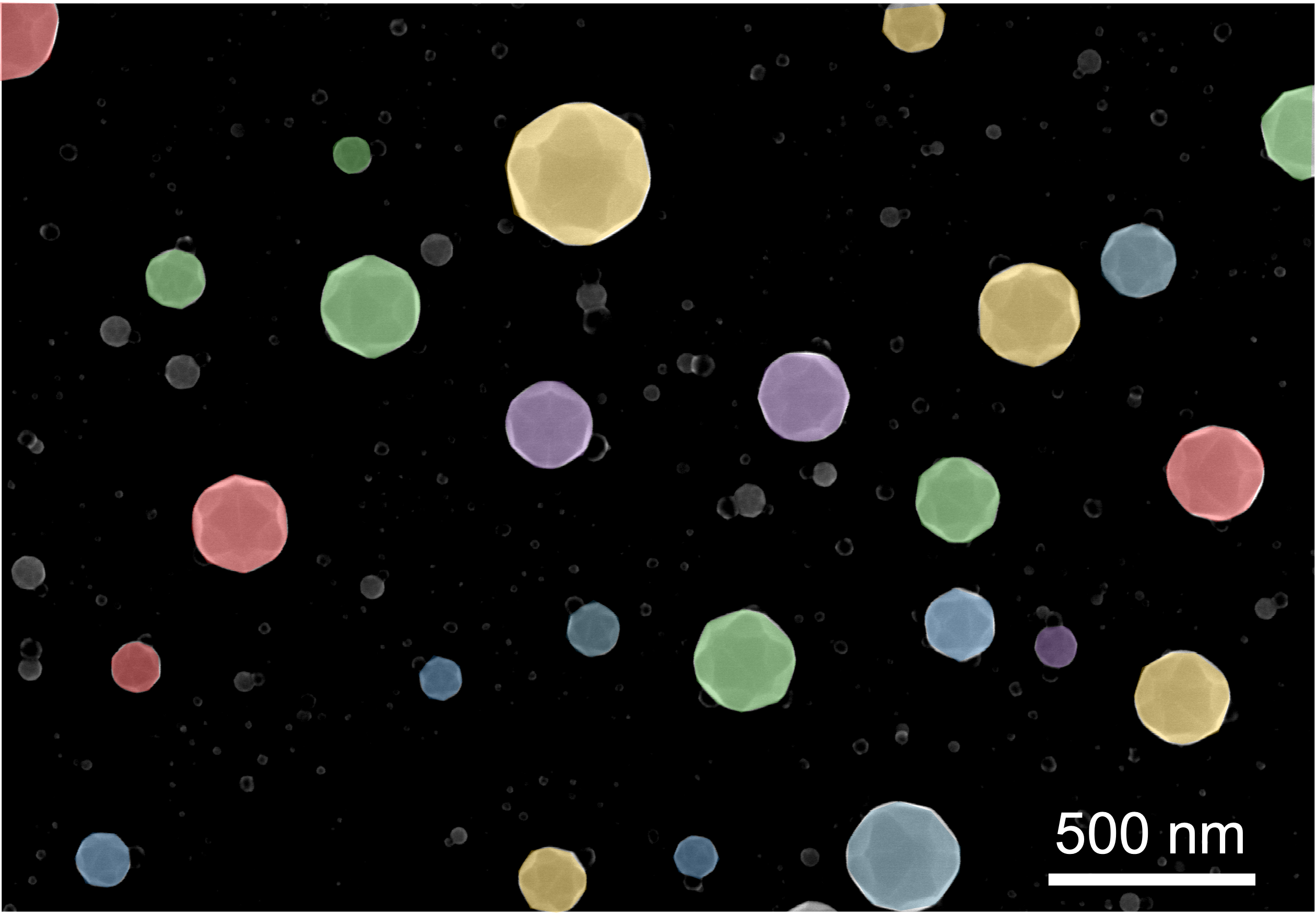
6. Colored scanning electron microscopy image showing multiple high-index-facet high-entropy alloy nanoparticles in the field of view
A new three-step method and the megalibrary platform open a systematic path to discovering next-generation high-entropy alloy catalysts
High-entropy alloys have long been considered promising catalysts, but until now scientists could not control their surface structure at the nanoscale, making it impossible to study how particle shape influences catalytic performance. A new study led by Northwestern’s Chad A. Mirkin and Christopher M. Wolverton changes that, reporting a three-step synthesis strategy that gives researchers simultaneous control over both the composition and surface facets of these nanoparticles for the first time.
“High-entropy alloys have been a black box for catalysis because you could never control the surface. We fixed that, and we did it in a way that works across different metals and different chemistries. Then, we scaled it to millions of particles. Now, you can actually study these materials in the way that they deserve to be studied,” said Mirkin.
The study, “A Three-component Strategy for Synthesizing High-entropy Alloy Nanoparticles with High-index Facets,” was published in the Journal of the American Chemical Society on April 20. Read the full story at Northwestern Now.