Nanotechnology at Northwestern, News
IIN’s Materials Discovery Work Meets Illinois’ Quantum Moment
April 24, 2026
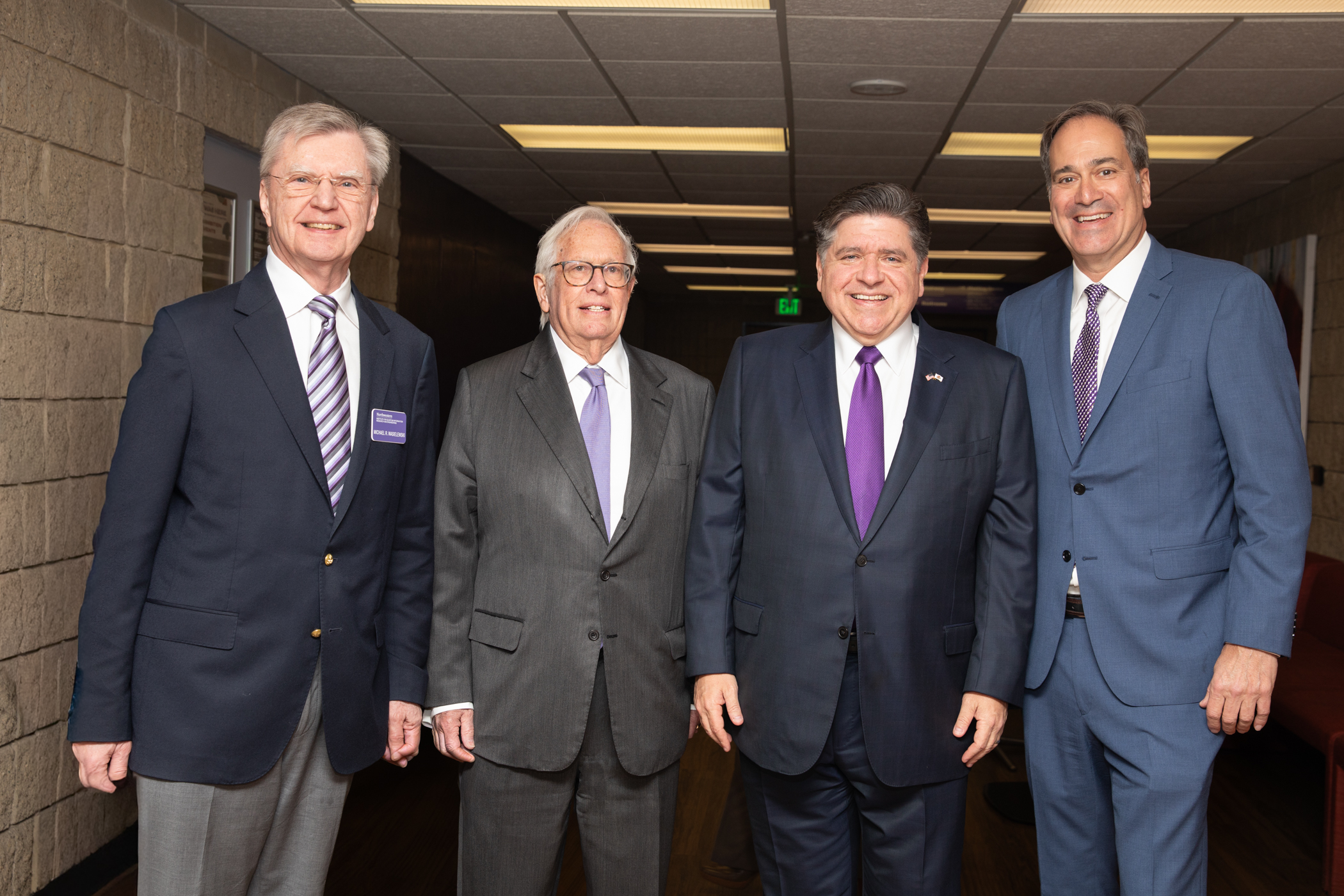
INQUIRE Director Michael Wasielewski, Interim NU President Henry Bienen, Illinois Governor JB Pritzker and IIN Director Chad A. Mirkin at Northwestern University during Northwestern Quantum Week. Photo by Eileen Molony
A new NQAC award at Northwestern is linking Illinois’ expanding quantum ecosystem with the materials discovery efforts already underway at the IIN, including the megalibrary platform and Mattiq.
Finding better materials sounds simple until you consider the size of the search. Even small changes in composition, structure, shape, or surface chemistry can change how a material behaves. That is why materials discovery has often been slow, expensive, and difficult to predict.
At the International Institute for Nanotechnology (IIN), researchers have spent years working on ways to change that. One of the clearest examples is the megalibrary platform pioneered by Chad A. Mirkin, director of the IIN and the George B. Rathmann Professor of Chemistry at Northwestern University (NU). Megalibraries allow researchers to create and screen millions, and in some cases billions of positionally encoded nanomaterials on a chip, providing scientists with a faster way to explore large material spaces.
That work is gaining momentum as Illinois builds its quantum ecosystem. During Northwestern Quantum Week, the National Quantum Algorithm Center (NQAC) at the Illinois Quantum and Microelectronics Park (IQMP) announced five Grand Challenges awards to support the development of quantum algorithms for practical applications. One of those awards went to Northwestern researchers Nikos Hardavellas and Roberto dos Reis for “A Hamiltonian Simulation Compiler for Drug Design and Materials Discovery,” a project with IBM and AbbVie that aims to make quantum systems easier for all researchers to use for molecular simulations related to drug discovery and materials design.
At NU and the IIN, materials discovery is linking the quantum and nanoscales.
Megalibraries changed the scale of the search
Traditional materials discovery often involves making a material, testing it, adjusting the recipe, and trying again. That approach can work, but it moves slowly when researchers are searching across enormous numbers of possible compositions and structures.
Megalibraries make the search faster. Instead of testing one material at a time, researchers can prepare large sets of nanomaterials side by side, then inspect them for the combinations that perform best. That can help speed up work on catalysts, optical and clean energy materials, stimuli-responsive structures, and electronic components.
This discovery philosophy also led to the creation of Mattiq, a Northwestern startup rooted in Mirkin’s research. Mattiq advances materials discovery by integrating the high-quality, big data generated using megalibraries and nanotechnology with artificial intelligence (AI).
Mattiq also shows how nanoscale discovery can move beyond the academic lab to accelerate the search for new materials, including materials fueling the global energy economy.
Quantum algorithms enter the picture
Quantum computing is still an emerging technology, and the NQAC announcement focuses on a practical next step. It is about building algorithms and tools that can help researchers apply quantum systems to difficult problems in chemistry, medicine, energy, and materials science.
Speaking at Northwestern, Governor JB Pritzker framed quantum as a major part of Illinois’ scientific and economic future. He described Northwestern as an integral part of the state’s quantum hub and pointed to Illinois’ universities, national laboratories, industry partners, and public investment as part of a broader effort. He also named advanced nanomaterial design as one of the possible long-term applications of quantum technology.
That point lands close to home at IIN. Nanomaterial design is already a core part of our work. The key question is how new tools, including quantum algorithms, can make this process faster, more predictive, and better aligned with industry needs.
A bigger toolkit for finding better materials
The search for better materials is evolving. Instead of relying on slow trial-and-error, researchers are turning to platforms that can create, measure, model, and learn from materials at much larger scales.
Megalibraries have helped define this future, while Mattiq is bringing that approach into the marketplace. The NQAC Grand Challenges award at Northwestern highlights another opportunity, where quantum algorithms could help researchers simulate molecular interactions and materials behavior in new ways.
The IIN, megalibraries and Mattiq show how much of this work is already underway at Northwestern. NQAC and IQMP add another piece, giving Illinois a stronger foundation for the next stage of materials discovery.